
The AQL table is the standard reference used worldwide to define a statistically valid sampling plan for product inspection. It translates your lot size and chosen inspection level into a precise number of samples to check and the maximum allowable defects for each defect class. Below we explain the standards behind the table, the two tables you use, and how to read them.
Which Standard Is the AQL Table Based On?
The modern AQL tables originate from the U.S. military standard MIL-STD-105E, which has since been replaced by two civilian equivalents:
- ISO 2859-1 — the international sampling standard (used by CGF Inspection and most global buyers).
- ANSI/ASQ Z1.4 — the U.S. national equivalent.
Both use identical sampling plans, so a plan built on one is valid under the other.
Table 1 – Sample Size Code Letter
The first table maps your lot or batch size to a code letter (A through R) based on the inspection level. Level II is the default general level for most consumer products.
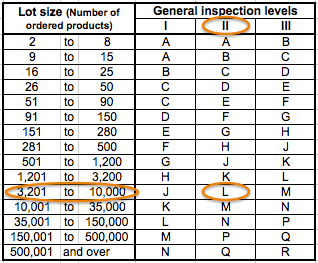
Example: a lot of 5,000 pcs at Level II returns code letter L.
Table 2 – Acceptance & Rejection Numbers
The second table uses the code letter plus your chosen AQL to give the sample size and the acceptance (Ac) / rejection (Re) numbers for major and minor defects.
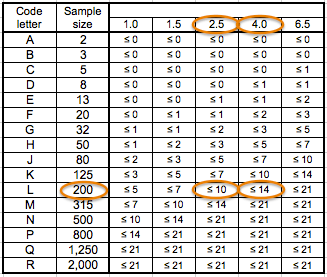
Example: code letter L means inspect 200 samples. At 2.5% AQL (major) and 4.0% AQL (minor), you reject the lot if you find more than 10 major or more than 14 minor defects.
How to Choose Your AQL Levels
- Critical defects (safety / hazard): AQL 0 — zero tolerance.
- Major defects (product unusable): typically AQL 1.0–2.5.
- Minor defects (cosmetic): typically AQL 2.5–4.0.
Common AQL values buyers request are 1.0, 1.5, 2.5 and 4.0. Stricter products (toys, electronics) use lower AQLs; simple goods may use 4.0.
Single, Double & Multiple Sampling
ISO 2859-1 supports single, double and multiple sampling. Single sampling (one sample, accept/reject) is the most common and what CGF uses by default for Pre-Shipment Inspection (PSI) and During Production Inspection (DPI).
Build your sampling plan in seconds
Try the free CGF AQL Calculator, or book a third-party inspection and we will apply the correct AQL table on site.
Get a Free Quote Open AQL CalculatorFrequently Asked Questions
What standard is the AQL table based on?
The AQL tables come from MIL-STD-105E and are now defined by ISO 2859-1 (international) and ANSI/ASQ Z1.4 (U.S.). CGF Inspection applies ISO 2859-1.
What does AQL 2.5 mean?
AQL 2.5 allows a maximum average defect rate of 2.5% for that defect class. On a 200-piece sample it permits roughly up to 10 major defects before rejection.
What is the difference between Level I, II and III?
They set how many samples are taken: Level I = reduced (fewer samples), Level II = normal (default), Level III = tightened (more samples, stricter).
Does CGF provide the AQL table on site?
Yes. Our inspectors carry the full ISO 2859-1 AQL tables and apply the agreed sampling plan during every inspection, with results in a 24-hour English report.